Saturday, March 31, 2012

The Tree of Life


It's hard to argue with an artist. Terrence Malick is an artist. He can be maddening and intimidating. You take his guff because he gives the goods.

I will thank Mister Malick for saying what he had to say and not talking down to his audience. I will ask him why he felt the need to bring me up to speed on the formation of the universe. It looked beautiful, undeniably so. I understood what I was watching. I even felt awe briefly. I think I saw God without a face. Then it kept going and going. I will admit that I needed the voice over to break up the beauty. I was waiting through the beats of evolution and time for a human voice to break through. I was waiting for Miss Jessica Chastain and Mister Brad Pitt (their performances a wonderful dichotomy of restraint and intensity respectively) to return to view.

The goods was the human story. I didn't grow up like the eldest boy in the film. My mother and my father didn't raise me in the same manner, but I will tell you quite honestly that I was struck by how true this loose narrative was. Terrence Malick knows what its like to be a son, to be a brother, and to be a boy. I recognized myself in Young Jack. If I'm to believe Adult Jack is recounted through a loose, disjointed trip down his childhood memory lane (and I believe I am), then this is the way to do it. At once immediate and distant like a memory, the journey is wonderfully executed.

Malick can be a poet. In fact, I would say he's more a poet than a filmmaker. It's not a slight. I just can't understand how someone can write The Tree of Life. Honestly, it had to appear on the page more as poetry than the format of a script. A moment is a moment and changes to the next. The cuts are quick and artfully seamless. I was prepared to hail the herculean triumph of a single editor, but the film's IMDB page credits five editors. It remains a supremely edited movie. It's the sum of whispers of moments, at once memorable and fleeting.

I was hearing Christopher Plummer's voice in my head throughout the movie. Plummer has said that he'll never work with Malick again, and Malick overwrites everything to the point of pretentiousness. I saw his point, but respectfully counter with "if that's overwriting, what's underwriting?" Malick is full of big ideas and a grand vision, but I can say with certainty that each word audible in The Tree of Life (though numbering a relative few compared to, say, Aaron Sorkin's works) matters immensely and is always meaning more than what we hear. There's a strange economy to his dialogue. It is art. It screams skill. How else could he write a film both bombastic showy and utterly basic?

***1/2

Thursday, October 27, 2011

Quarantine


Found footage movies are nothing new. The buzz behind The Blair Witch Project and Cloverfield has given way to two or three such movies every year, mostly of the horror genre. Its conventions best utilize the first person camera narratives. With more of these movies, the quality has begun to even out. For every success, there's a dip. Most recently, Apollo 18 came and went. Quarantine ended up right about the middle of the newly found spectrum. For a real time movie, it spends an unusual amount of time developing its characters. That doesn't keep the filmmakers from throwing the same characters to the lions without blinking. Yes, this is a horror film through and through. It's a bloody, scary movie with the obvious trajectory towards a bloody, scary end. It's a B-movie made with the A-list in mind. The ensemble play their parts well. No one phones it in. There's not much to what they have to do, but I thought they did it exceptionally well. The whole movie is a bit ridiculous, but the filmmakers and performers play it straight. The audience benefits. A major scare, but a minor movie. I wonder how a staged performance would play out...

***

Somewhere


Sofia Coppola has my loyalty. I find her to be an interesting filmmaker. She has a proven track record. I loved Lost in Translation and Marie Antoinette, and really enjoyed The Virgin Suicides. From here on out, when she makes a movie, I want to see it. Somewhere isn't what I expected. It's a VERY atmospheric character-driven movie, which is to apologetically say very little happens. I can be on board for that, but I needed more than what was given. Stephen Dorff is not my favorite actor. Truth be told, I can't find a single redeeming performance in his filmography. He should be perfect in the part of a B-list actor who falls asleep to pole dancing ever other night or so. He kind of is. I can't think of an actor who'd play the part better. The problem is, he doesn't have much to play. He has a few choice scenes where he gets to ACT, and he plays them fine. I wanted more. I wanted Coppola to give him more to do, more to say, and more to be. If the story of an long-absent parent whose new quality time with their child leads them to reexamine their life sounds familiar, you'd be right. Elle Fanning, so full of life and vigor in Super 8, is quiet, sweet and dull as the returning child. Coppola doesn't play it conventional. She's more interested in how the quiet in a noisy scene can convey a character's loneliness or emptiness without hitting you over the head. I want to be rewarded for noticing. I want my attention to be worth something in Somewhere. Instead, Coppola is inching closer to the sparse atmospheric movies of another indie-auteur, Gus Van Sant (Elephant, Last Days, Gerry). I don't like it.

**

The Ides of March


The Ides of March won't change your mind about politics or offer new insights into the morality of politics. I don't think it tries. Writer-director George Clooney is too concerned with delivering complex characters to care how you feel about them. Ryan Gosling is the lead and is in just about every scene, owning each one along the way. Rather than go with his recently maligned method acting or the minimalist performance he delivered in Drive, he plays his Stephen Myers as a charismatic lightning rod. Even when the plot knocks Myers down a peg, Gosling plays him upright, always pushing his feet forward. My only criticism, one that lowered the movie's impact, was the ending. I can't claim to be an glass-half-full type of person, but after the journey the characters soldiered through, I wanted more leeway. I wish Clooney had let us make up our minds rather than paint Myers into a corner. It might be nitpicking, but the question I've been asking since walking out of the theater is what is more interesting, The Godfather route or something more ambiguous? Is there a right answer? Maybe I'm just mad Clooney and Gosling got me to like their leading man before his ambitions got the best of him.

***

Thursday, September 29, 2011

Killer Elite


Lo and behold, Killer Elite starring Jason Statham, Robert De Niro, and Clive Owen was underwhelming. I was hoping for another surprise a kin to the Statham-led The Bank Job from a few years back. This is not that.

Statham does his thing. He doesn't stretch. No on ever asks him to. I finally convinced myself to check out Killer Elite because Clive Owen was in it and I am definitely a fan. No one really phones it in, but it is also clear no one is able to rise above the material. Start the cliches. Jason Statham plays a hit man who leaves the profession after a child witnesses one of his hits. Check. It humanizes our criminal protagonist. He's pulled back into one last job. Check. He reluctant to leave his new life for the one he left for good reasons. He's in love with someone who doesn't understand what he does or did for a living. Check. Our protagonist needs to be conflicted, doesn't he? The antagonist with the upper hand circles protagonist and delivers needless exposition instead of winning? Oh, oh, oh! Check. I've seen it before and better, even from De Niro in The Score.

To make matters worse, the trio of stars are forced to deliver mediocre dialogue throughout and the story hinges on moments of illogic or convenience to move the plot forward. The film claims to be based on true story, but I'd rather see something I can believe.

I like Jason Statham. He's likable and baddass enough to root for, but after seeing the movie and taking into consideration it's historical roots, I can't be the only one who would rather see a movie starring Clive Owen's former SAS officer protecting former SAS officers and the interests of the secretive "Feather Men" society. Ditch the cliched hitman plot that we've seen enough times to recite ourselves and show us the part of your project that holds real fascination and intrigue. Don't make De Niro run around and take down henchmen. It worked in Ronin, but that was a long time ago.

Somethings work. I can admit to the thrill of seeing a knock-down-drag-out brawl between Statham and Owen. I also enjoyed...well, that's really the highlight. Meh. Oh, and Owen rocks that mustache.

"The script is a mess. It's an object lesson in taking a nonfiction book ("The Feather Men," about a cadre of ex-British Special Air Service operatives) and making a hash of it." - Michael Phillips, Chicago Tribune

**

Tuesday, September 27, 2011

In the Valley of Elah


Paul Haggis is probably most famous for writing and directing the Oscar-winning film Crash. I was a huge proponent of the film for a long time. Upon repeat viewing and further thought, it doesn't age well. Initially, the emotional impact is huge. Looking back on the technical aspects, one can see how blatant Haggis pushed those responses with musical swells and compression. There's more than one story in the film that doesn't need sandwiched in. It's a good film. I won't argue against that.

Watching In the Valley of Elah, Haggis's followup to Crash, I kept these trends in mind. For much of the film, Haggis shows refreshing restraint. This is a quiet and deeply felt film. For the first two acts, Tommy Lee Jones (as the film's lead, Hank Deefield), anchors a well-told tragedy. It's really only in the film's last ten minutes or so that Haggis can't resist turning the screws on the impact. He was so close to a great movie. He really was. Hank's final moment is almost earned, but is ruined by unnecessary soaring music. It's as though Haggis doesn't trust his audience to feel according to his expectations. There is also a mishandling of the film's metaphorical title. It's from the biblical story of David and Goliath. It gets referenced not once but twice. The second time is too obvious to show the trust from Haggis that he and I had earned up to that point. There's really only one conclusion to come to from its inclusion. Let me come to it on my own.

Tommy Lee Jones earned his Oscar nomination as Hank. It seems like the typical Jones role because it is. His gruff red state man's man who won't back down or take guff from no one is his bread and butter. I think we just take the actor for granted. Casting him is a no-brainer, but that may be only because no one in their right mind would want anyone else playing this role. It needs Tommy Lee Jones.

The cast utilizes several former servicemen in supporting roles. They are not actors by trade, and it shows at times. Yet, there are startling key moments of real force during these performances. I can't dismiss them as non-actors (indeed, all of them have gone on to take more roles in Hollywood), when they can go to those places for the film.

Haggis's stock in Hollywood has slid since his surprise Oscar wins six years ago. He has talent. He just needs to trust his audience. We're smarter than he thinks.

***1/2

Sunday, September 25, 2011

Moneyball


It's hard to think of a more tired cliche than a rag-tag group of under-performing sports players rising together to win the big game/championship/title. If it's done right, that type of sports film can be great. I have seen it before. Moneyball has elements familiar to the genre. The new aspects are more interesting. Moneyball is a political movie without parties. Co-writer Aaron Sorkin created similar character dramas with the White House staff, a sketch comedy staff, and a sports highlight show staff. Moneyball is in that territory, but lacks the usual intelligent zippy dialogue that we know from every other Sorkin script. Credit Steve Zaillian, an Oscar winning screenwriter in his own right, for tempering Sorkin's flair with a believable tone. These people talk like baseball people. It'd be impossible for Billy Beane (the General Manager of the Oakland Athletics at the center of the story) to look like Brad Pitt, but they can sound alike. I can believe that. There isn't a single showboating performance among the cast. I can't call Philip Seymour Hoffman, Brad Pitt, and Jonah Hill a rag-tag group of under-performing actors. I won't. I will say that they blend together like a real team or ensemble. Hoffman in particular is notable for his ace albeit small role as the Athletics stubborn manager Art Howe. Hoffman's previous work with director Bennett Miller won him an Oscar for his title role in Capote. Art Howe is not Truman Capote. They don't require the same level of bravado or acute mannerisms. Both performances have to work. It's absolutely Pitt's movie, but the "role players" fill the gaps effectively. Pitt is given a character with fun dichotomies. He is both immensely confidant and determined, while quietly vulnerable behind those dreamy eyes. He puts his eggs in the science and statistical baskets, but wavers when his presence at a big game might jinx the outcome. Pitt's very good, but doesn't have to showboat the way he did in his last awards-worthy performance as Benjamin Button. This isn't that kind of movie. It's a sports movie not only about its team, but rather about the entirety of sports. It's not a political revolution Billy Beane and his forward-thinking protege Peter Brand (Jonah Hill in a solid supporting turn) are starting, but, onscreen, it's just as engrossing.

"A smart, intense and moving film that isn't so much about sports as about the war between intuition and statistics. I walked in knowing what the movie was about, but unprepared for its intelligence and depth." - Roger Ebert, Chicago Sun-Times

****

Friday, September 23, 2011

Jack Goes Boating


Jack Goes Boating is a somber buzzkill. It does not create the buzz it kills, but is more than willing to quell whatever spark of expectation you bring in. It is a romantic film only in that it deals with romance. I can appreciate the dichotomy of presenting two couples at either end of their romantic entanglements. Yet the struggling couple is too busy and frantic to be entertaining. I don't really like any of the characters. Even the film's protagonist, Jack (Philip Seymour Hoffman pulling double-duty as director and lead actor), becomes difficult to root for as he lets himself become mired in his friends' infidelities. His new romance deserves more of an featured oomph, but is overshadowed by what the filmmakers hope to get across about the entirety of fidelity, love, and their respective behaviors. The humor that was promised was almost nonexistent. There are attempts that don't fail miserably, but I couldn't find a chuckle in my body. Some of the quirks found within the characters are amusing, but I couldn't bring myself to smile the whole time. I found the tone to be quite somber. Even as the quartet of performers reach a rolling boil during a climatic dinner, there's a rain cloud hanging over the entire affair. The film is based on a stage play, but I wonder if seeing the production on stage would change my perception. In truth, some of the cinematic interludes are the most involving. Jack learns through visualizing swimming and cooking. While those moments are a tad out of place, they certainly add some artistry to the film. Also glaring out of place is the film's indie hipster soundtrack. All the songs chosen (save Jack's motivational reggae) are beautiful, but don't fit the film. Some equally subdued Simon and Garfunkel or even Elliott Smith would have been perhaps contrived or overly familiar but more appropriate. There is nothing hip or cool happening on screen. In fact, there isn't really much worth mentioning happening on screen. There are some truths to what the film has to say. Some of the resulting conclusions this new couple comes to are to be admired and embraced, but I was hoping for more of the nuance I have come to expect from Mister Hoffman and his leading lady.

"Ultimately, though, Jack Goes Boating is too much of a banal thing. Jack's a good guy, and you root for him all the way to the end, but, wistfully, that doesn't make him an any more interesting everyday Joe than he is." - Marc Savlov, Austin Chronicle

**

Contagion


Awesome. Can you recall the last time that you participated in a movie? I got up to use the restroom about 40 minutes into Contagion and covered my mouth with my fist to cough. I felt guilty. I washed my hands thoroughly and took extra care not to touch the door handle to the restroom. It was amazing to be that involved with what I was watching. It's an engrossing ensemble drama that consistently asks a interesting question: When the health of our populace is threatened, how scared is too scared? Terrible things continually escalate in proportionate and disproportionate reactions from the all-star cast. None of the stars play it too strong. I was immediately aware of the skill in direction, acting, and writing. It's a quiet film. It's not a flashy film. It's absolutely stylized. There are a few times when the score clashes its mighty flares a kin to a Hitchcockian melodrama. It looks cold and certainly not unintentionally sick with all it's hospital whites, damp yellows, and winter blues. However, it's restraint and assured pacing shows its pedigree. Contagion seems to frequently be compared to Outbreak, a film to which Contagion only really relates in its most basic conceits. Outbreaks was a medical and military thriller, whereas Contagion is quite content to be a medical and political drama grounded in its diverse characters. Maybe it could have used more infected monkeys, but I don't think so.

"The circumstances depicted in Contagion are terrifying, but the power with which the film is made blends the horror, as only the best art can, with beauty." - Shawn Levy, Portland Oregonian

****

44 Inch Chest


44 Inch Chest is a mess of movie. It's starts off interestingly enough. It contains richly detailed and wholly specific characters who never quietly say everything on their minds. The script contains some absolutely wonderful monologues, but it also derails in its final act. I wanted to be rewarded for sticking with the film, but the last act grows too convoluted and/or uninvolving to earn that attention. I've heard that it was originally intended to be a staged play. I can see it in the setting and story. It's mostly confined to one room and remains very dialogue heavy. I have my doubts that the psychological aspects could be made any clearer in a playhouse. There's meat to the project, I just wanted to get to it sooner and with less vitriol and posturing.

"It feels very much more like a direct adaptation of a stage play (which apparently it's not). The filmmakers do goose things up by playing with reality in the second half, but it all leads to a payoff that, while perfectly legitimate, feels limp." - Andy Klein, Los Angeles Times

**

Drive


Wonderful, gritty, pretty, discomforting. It's a beautifully created film where each moment is engineered artfully. It's not an anally manicured film. There's a simple, non-exaggerated dreamlike quality to the whole production. Still, when the story heads into nightmare territory, the style remains constant. While the violence can be startling, I felt the appropriate cringe for the first time in a long time. My connection to these characters, in spite of their quiet nature, was deep enough to instinctively empathize with the danger. It's a flashy brilliant piece of pulp.

"'Drive' looks like one kind of movie in the ads, and it is that kind of movie. It is also a rebuke to most of the movies it looks like." - Roger Ebert

Filmspotting's Thoughts

****1/2

Sunday, October 24, 2010

The Social Network


My review of The Social Network will be pedestrian. I am immune to the film's flaws. I am in awe of Aaron Sorkin's script.

The script is one of the best I've ever seen on screen. His words have a cadence outside my experience. People don't talk like that. I mean, they do. I don't. Not that quickly and with such complex sentence and paragraph structuring. These legitimate brilliant characters might. I'm glad they do. I expected the script to be entertaining. I didn't expect it to be so smart, though. Your attention is rewarded. You're not going to follow all of it, but you will get it.

The Internet coding and legal jargons aren't important. They are to the characters, they don't have to be us laymen. What's better is watching them say these things. Language and intelligence are weapons in a battle of social interaction Mark Zuckerberg is ill-equipped for.

The film is largely about men. To say the film is misogynistic misses something. There's hardly any women in the movie. Two of the only women present (Zuckerberg's ex-girlfriend and legal aide respectively) put him in his place. Yes, some of the other women are portrayed as sexual and/or status objects. I'd argue it's less so than any teen or frat comedy doled out year after year.

Yes, back to the men. To say Zuckerberg is a self-absorbed, egotistical, socially-inept asshole misses the point. He's fascinating. How could someone like THIS become the world's youngest billionaire? Show me. Thank you. That's interesting. Jesse Eisenberg has been pegged as the poor man's Michael Cera. He destroys that comparison. Cera never could have done this. Eisenberg rules the gatling gun dialogue while simultaneously conveying intense layers underneath. There is literally ALWAYS something going on with his Zuckerberg. I loathe and pity the character all at the same time he is loathed and pitied by those caught up in his rise.

The supporting performances are less...flashy (?), but uniformly solid. Andrew Garfield serves as the audience's POV. He's clearly smart, but is always trying to play catch up to these geniuses running circles around him. While he's loyal, his frustration is our frustration. Garfield was twitchy (?) in Boy A and Never Let Me Go, lost and crazy eyed in Red Riding 1974. He's doing something more understated here. Justin Timberlake plays to his strengths. His charismatic Sean Parker carries JT's charisma with him. Only in the third act when he becomes a too obvious villain does the film falter.

It's cliche to say that The Social Network is the film of our time. Up in the Air held that moniker just last year. But the Social Network does capture the new media in a way that no other film has before it. Young people has been shown to be awkward, status-obsessed, and self-absorbed before, but never in this context.

Andrew Gates is now friends with The Social Network.
****

Never Let Me Go


Never Let Me Go is a cold film. It's beautiful, sure. But it's cold. The only warmth and tenderness (quite intentionally) comes from the interaction between Kathy and Tommy. Circumstances both familiar and strange keep them circling each other, but their affection is always readily recognizable. This is a film of subtlety. Even when you long for it to smack you over the head with grandstanding bravado, it takes its time to simmer slowly. The first act echoes this. It should be slimmer. We spend time with the three leads as children. Even though the adult trio of Carey Mulligan, Andrew Garfield, and Keira Knightly easily overshadow their younger counterparts, the film holds fast to the story and character development.

The story's science and politics didn't interest me. I wonder if they even interested the writers. What kept me involved was that warmth and tenderness in the performances that conveyed those feelings in the midst of cold beauty. Carey Mulligan and Andrew Garfield are real talents. These two can win Oscars (the new Spiderman be damned). Their work here isn't flashy enough to stick in the minds of the Academy, but it stuck with me. Love found too late, but found nonetheless is the crux here. Its because the science and the politics are secondary issues to their relationships that the film works.

***1/2

It's Kind of a Funny Story


It's Kind of a Funny Story's chief draw was its writers/directors (the same team that did Half Nelson). That film was raw, immediate, and wonderfully ambiguous. That's mostly lost in their new film.

What it does have going for it is Zach Galifianakis. His performance is actually amazing. It appears effortless in the best way. He slides from quirk to poignancy without showing the seams. He steals the show. Poor Emma Roberts gets a good character only to be slighted with screentime. The impression her Noelle makes on the audience pales in comparison to the one she makes on the film's protagonist.

I related quite a bit to the story the first time through, recognizing bits and pieces from my own life. The story treats mental health issues with heft without ignoring an audience's need to be entertained. If the ending fails to continue that commitment, oh well. That's Hollywood. I smiled. I felt my heart swell. The second time through, the nostalgia had diminished. I saw the flaws. IKOAFS strives for that independent film spirit while trying to straddle the mainstream. I wish I hadn't read a review where the film was likened to the films of John Hughes prior to seeing the movie. Once that seed was planted, some of the film's originality was lost to me.

The fantasy sequences/freeze frames/narration largely don't work. They try too hard. When the film relaxes and lets the characters interact on a real playing field, it hits its stride. Good movie, but I wonder what the writers/directors of a film like Half Nelson could do with this material. Oh...wait...

***

Sunday, December 27, 2009

Up in The Air


I was quick to jump on the bandwagon of director Jason Reitman's last outing, Juno, after seeing it two years ago. I loved it. After reading the script, I loved it less. Reitman and his cast gave these quirked out suburbanites' quotable dialogue nuance that was present on screen and glaringly missing on the page. Simply put, you had to see it to believe it.
Working from his own adaptation of Walter Kirn's Novel of the same name, Reitman's Up in the Air succeeds where Juno lost its footing. Its script is amazing. Its cast is impeccable. And this time, Reitman has raised his own game visually.
George Clooney stars as Ryan Bingham, a "termination facilitor". It means people hire him to fire their employees. He fancies himself a professional. It's clear in early scenes that he excels at his job as much as one could hope to. He's quick on his feet and focused. What I misjudged first as callousness reveals itself later as resignation to the inherent difficulties of his job.
His character has also resigned to the idea that he's better off moving about free of emotional and relational tethers. He's a man without a home by choice.
It's when he's faced with the prospect of staying foot that Bingham starts drowning. His final trip to train an overeager corporate upstart (played beautifully by Anna Kendrick) lays it out for us. Faced with staying put and digging in at his supposed home of Omaha takes a backseat to one last venture out in his beloved airplanes to stay in hotels, eat lounge dinners, and swap drinks and spit with a bewitching fellow traveller (played with deceptive layers by the excellent Vera Farmiga).
It's not terribly surprising that along the way he comes to question his choices, his relationships and lack thereof. What is surprising is how natural Reitman and Clooney make it appear. Even when the answers seem easy, they're not. Even when the glass is half-empty, it remains half-full and vice versa. It's this balance of sweetness, humor, and grim reality that mix to create a film for now. It's been called "The Film of this moment" too often to actually fit the bill. With that in mind, it comes damn close. There isn't a false note to be found in the movie. The emotionally heavy-lifting isn't there. But the movie is more than skin deep, too. It's just right like Baby Bear's porridge. Clooney, Farmiga, Kendrick, and Reitman know well enough that drama comes both from action and reaction. So rather than calling it the movie of this moment in time, let's call it "a reaction to this moment" and soak it in for it what is: one of the best films of the year.

Also, somebody tell Reitman that his half-empty/half-full ending is just what Up in the Air needed.

****

Avatar


I want to speak in specifics, but I'm left only with abstract superlatives. Avatar blew me away. I was exhilarated in ways few movies have made me. Visually, Avatar was far superior to what I was expecting. I'm not talking about the 3D (though that was fun). I'm talking about the CGI performances of those long blue natives you see runnin' around in the television commercials. They're much better on the big screen. I was surprised by the amount of emoting these Avatars were able to do. Zoe Saldana in particular turns in an amazing performance under the guise of a blue alien. So much reality comes through in her voice and on that blue creature's face (created through motion capture), that you BUY IT. THIS CRAZY NONSENSE WORKS. Sigourney Weaver, however, loses something in translation in blue alien form. Don't know why. What works on both sides of the coin is Sam Worthington's performance. It's not groundbreaking thematically, but he's able to carry the story (an epic one at that) all the way through with ease. It's hard to explain. Let's just say that the awkwardness of his performance in Terminator Salvation is lost. He's at ease as an actor. He's found his stride as a performer.

James Cameron has always excelled more as a visual storyteller and as an idea man than a screenwriter in my eyes. Some of that military grunt and scientific babbling blah blah blah is still here, but the extraordinary visuals have a grounding in these characters. Even as the supporting characters weave in and out of their degrees of value and credibility, Worthington and Saldana are there to bring us back. And don't ever question the visuals. Simply put: they're amazing.

I was surprised at how involved I became in the story. I literally sat on the edge of my seat biting my fingers. I was into it. Whether or not that fascination wanes upon further viewing remains to be seen. For now, I am satisfied in calling this one of my favorite films of the year and the easiest to recommend to everyone. You'll like it. Unless you're stupid. Just kidding. Mostly.

****

The Box


It's hard to praise The Box. It's so stylized, that any sort of originality or individuality is blurred. Its source material, a science fiction short story, has previously been played out in a Twilight Zone episode. It's that same sort of melodrama and tweaked atmosphere that is played out in Richard Kelly's film. I wouldn't be able to stand the musical score of the film, an amped up pulp orchestration, unless I viewed it as a key component of Kelly's intent. This is not a modern film. Some guy in the late 70's, early 80's could have matched the result (minus some of the special effects). Kelly wants to tell a tale in a slightly more innocent time on the cusp of 80s greed and subsequent immorality. What Kelly has going for him is the conceit. What would you do? How would you deal with the circumstances?

Also working for Kelly is his casting of James Marsden. The former Cyclops has acting chops. He makes the most of the hackneyed dialogue that Kelly gives him. It's his eyes, his urgency, his increasing fear that comes across the best. Unfortunately, Kelly's A-Lister, Cameron Diaz can't save her dialogue. It might be the accent that buries her, but she's hard to believe for much of the film even as the unbelievable happens around her and her husband. Frank Langella acts past his characters facial deformities to create a mysterious villain (?) worth remembering. It's when his intentions become clearer that the film breaks its brakes and nosedives towards its climax that the film loses traction.

It's freaky, intentionally so. In a dark theater with surround sound, it's scary. Still, sitting there I was thinking ahead to watching it at my house on my 13-inch TV. There, it might be silly, laughable even. Time will tell. In his effort to make us scratch our heads, to question what we see and what we hear, Kelly may have pushed the style too far. I shouldn't be giggling. I should be squirming in my seat uneasily. Sometimes at the theater, I was.

The film bends under the weights of its director's need to mind-screw his audience. The final scenes don't work. As far as the questions Kelly raises, I kept asking myself these long after I left. As cinema, The Box is slight. As science fiction, it's intriguing. I would watch it again to see how it holds up. There's good there hiding out amongst the missteps.

***

Carriers


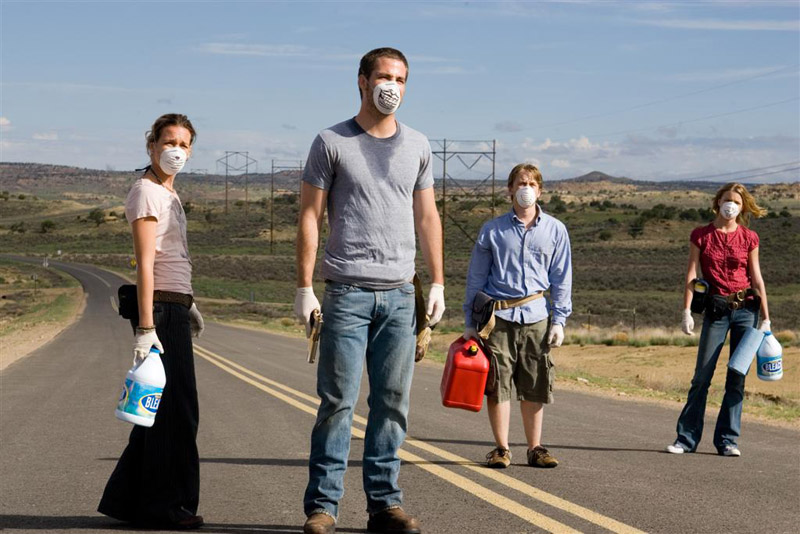
Carriers comes hot off the success of its star's other big 2009 movie, Stark Trek. Chris Pine has made a name for himself. That name wasn't enough to get Carriers much of a theatrical release, but it was enough to lure me in for a viewing. The prospect is enticing: a unnamed virus is making people sick - not zombies - and two brothers and their respective love interest head for the beach and some notion of outlasting the carriers. Nobody's biting anybody else. But the virus is easily caught and acts quickly. Chris Pine plays a brother quick to dismiss the victims, while his younger bro, Lou Taylor Pucci (of Thumbsucker fame) reacts uneasily at every turn to his brother's callousness. That dynamic creates the friction the film will carry to its uneasy end.

Pine shines in a complex role. It's a bit showy, but Pine shines with these kind of opportunities. His seemingly numskull frat beard has seen some things/done some things that have shaded him differently. It's how Pine lets these unseen experiences compel his character that shape the performance. More so than the poorly titled, Jim Sheridan helmed melodrama Brothers, this film throws two siblings into harrowing circumstances and let's 'em rip. Pine sets the pace, but Pucci can't match it. His character is meant to be a pushover, a well-meaning-yet-toothless intellectual. Pucci just plays it bland. Emily Van Camp plays his maybe main squeeze while Piper Perabo plays Pine's long time girlfriend. Both turn in understated performances, and Perabo in particular impressed me in her scenes mid-film.

In the end, the film has a good setting and atmosphere, but cannot flesh beyond the surface of what could have been an affecting, bleak outing. Their plight is real, but none of the circumstances stemming from that plight payoff quite as much as I'd like them to. The filmmakers teased me. First, we have the scenes with Christopher Meloni and his daughter seeking out a cure at a outpost with the four weary travelers. Heavy stuff. Yet, the filmmakers only dip their toes in danger before moving their characters on. Next, they meet up with a creepy bunch of hazard suit survivors at an old resort. Again, the tension and stakes are high only to be dropped when our four stars head out to the next stop. It's meant to be post-apocalyptic fears played out between four road trippers. What works is their sparring. What doesn't is the lack of stakes outside their car. And please don't have Pucci drip profundities in voice over in the last scene as though it meant more. It could have, but it didn't. Carriers only sweeps the surface.

**1/2

Tuesday, December 8, 2009

Where the Wild Things Are


I felt strong pangs of nostalgia during this movie. More awkwardly, I heard the restless wrestling of the youngins' and their regretful parents around me. This was far too deep for humans not old enough to reminisce. Perhaps you have to be older than 18 to enjoy it, to be able to look back at your youth with regrets and longing. Max is a 9 year old to a fault. His haphazard imagination is full of tangents and half-thoughts. It's the moments of passing clarity (Max's fear when his Wild Things avatar, Carol, is off the handle; KW isn't wrong to seek out new friends; emotions are strange) that will fly over the heads of those 9 year olds in the audience. We old timers (at 27, I feel simultaneously part of the target hipster and the silly nonsensical kid demographics without wholly belonging to either) see the insecurities masquerading as confidence in Max. I got a lot out of it. The rivers in the land of the Wild Things run deep. Even as the Wild Things cumulatively lose the plot, I saw value in the confusion it created. It's about feeling alone and out of place even amongst a crowd, even in your own mind.

Spike Jonze steps out of the Charlie Kaufman shadow he helped create to claim his own vision. This is the work of a visionary cued to the artistic instincts of a master getting better, staying true to his gut. The film has moments of exquisite beauty, but the aesthetics are strictly rough around the edges - like Roger Deakins' family vacation home movies. If the film has failed to connect with viewers - I might just have to play the snob card - they just don't get it...or aren't old enough to get it yet. A child's psyche is a place where Wild Things roam. It's not high and mighty to realize I want my mom sometimes, and I don't ever have to say so. I can always go home. Even if cliches always say otherwise.

****

The Men Who Stare at Goats


This movie wasn't awful. Interested now? Oh, not really? Well, good. You see, after all the characters have ended their journeys, I was left feeling "meh". So what? The character arcs were utterly dissatisfying. George Clooney tried his best, but the script is too preoccupied with it's oddball cast of characters to tell their story. Yeah, they're goofy; but SO WHAT? In the climatic scene, where George Clooney and his mentor free the minds of the too serious, too sad, too capitalistic U.S. Army and its psychic advisers through LSD shenanigans only to disappear into the desert, I just wondered why it was supposed to matter to me. I liked Lynn (Clooney's character). He's about all I really LIKED about the film. Still, his triumph felt shallow. Ewan McGregor's accompanying journalist remarks about the profound effect Lynn had on him, but I can't really see why. What did any of these guys really do in the end? Why is their satisfaction important to me?

Note to producers: do not cast McGregor as your straight man. He can't do it. He's best as the wide-eyed, edgy dreamer. Would he have been better cast as Lynn? Nah. But he's lost to connect with the character he's given.

Meh.

Sadly, I think there was a good story here. If any of the background behind this story is true, I find it fascinating. This journey of enlightenment for McGregor and relevance for Clooney cannot match its potential. I guess I'll read the book.

**