Sunday, March 8, 2009

On Watchmen...How This Fan Watches the Watchmen by A. Gates


About a half hour into Watchmen, as the rude and crude Comedian was being laid to rest with Simon and Garfunkel's "The Sounds of Silence" playing sweetly in the background I thought to myself, "Oh, no. This is self-important pretentious posturing." Then, fairly, I thought back to the source graphic novel - the comic geek's War and Peace if you will. "Was that self-important pretentious posturing as well?"

The truth is, these concerns quickly subsided as I again surrendered myself to the story and, in this oddest of cases for this comic geek. the incredibly reverent storytelling. Watchmen, the graphic novel and the film, are self-important pieces of fiction stemming from the arrogance of the brillant weirdo Alan Moore. But, as anyone who really works through the deconstruction of the superhero myth that Alan Moore laid out 20+ years ago, it is objectively important. A social commentary, epically told superhero story with heroes afflicted with the human condition in all its debilitating glory.

Rorshach, easily my favorite character in both mediums, is a psychopathic sleuth with a brutal, uncompromising sense of justice. He's a jarring character, an socially inept weirdo in a costume who is also a mentally and emotionally scarred deviant working outside the law. On the page, his words are put in scratchy, sketchy balloons and we as readers are left to imagine what sort of unusual voice would deliver such oddly drawn speech patterns. And perhaps that's where the gift of the film begins. Jackie Earle Haley, that newly rediscovered talent from the 70s, was nominated for a Best Supporting Actor Oscar in 2006 for his work in Little Children. I thought the whole performance was overrated. After seeing his work as Rorshach, I reconsider. You see, his characters, although both scarred social outcasts, are on opposite ends of the performance spectrum. His brutality, his growl, his stiff anger as Rorshach is the foil for his Little Children's character's weakness, sadness, and quiet anger. And that growl(!), I am more than pleased to say, is exactly how I imagined Rorshach would sound even if it never occurred to me until I heard Haley's first words in the trailer.

But each of these performers in the movie playing these characters firmly placed in my memory is for better or for worse the perfect person to play their part (save maybe Carla Gugino as Sally Jupiter, playing it campy). I say for better or for worse because naturally some of these characters work better on the page than on the screen. Laurie Jupiter (aka Silk Spekter II), is one of those characters. And I won't fault Malin Akerman for any of it, though many reviews I have read turn quickly on her. She fits the part to a tee and executes it wholley reverently. But something about Laurie fits within comic panels better than the confines of the silver screen. As the naive and sweetly sexy ingenue heroine acting as knowing commentary on the comic book medium, Laurie Jupiter works. But that role in a film, that medium where we haven't seen that obligatory gal in spandex to the same effect, the character seems an odd fit. And to see her and her mother as the transition from the Golden Age to whatever the geeks are calling this age makes eerie sense in the comics and very little on film where the Golden Age has all but been ignored completely.

Kudos to Patrick Wilson, Haley, Billy Crudup, Jeffrey Dean Morgan, and Matthew Goode for their insight into bringing the pages and characters to life. Each is an uncanny fit for their character counterparts and whomever cast this film has to be pat on the back. Haley and Crudup are the standouts receiving all scant critical praise, and deservedly so. Crudup, in particular, delivers a performance of tremendous subtlety and restraint (albeit through a CGI avatar). His character is more than a comment on superheroes. Dr. Manhattan is a comment on religion and on God seen through a glass darkly. The insights, while not my own on this subject, are fascinating and bracing. It's a difficult character to bring to life, but Crudup and Snyder's team of special effects wizards more than conquer the challenge. Crudup's Dr. Manhattan, perhaps even more so than in his graphic novel incarnation, is an indelible film creation.

Zach Snyder and his screenwriters David Hayter and Alex Tse are aware of how to tell the story in this medium. The unnecessary parts of the graphic novel (or, for the fanboys who just gasped at the hint of anything in Watchmen being unnecessary, "medium-specific") are left out and the good stuff is left in. The big change to the ending pleased me the most. The crux of the graphic novel is perfect for that medium - a ugly monster spelling possible doom for the world and our heroes. But that doesn't work on the big screen where even the most outlandish of villains (I'm looking at you, Willem Dafoe as Green Goblin, and you, Colin Farrell as Bullseye) are more real than what is depicted in the last fourth of the graphic novel. So, bravo for the change. There's the fact that it is minor yet still makes the whole calamity at end actually work. The Black Freighter allergorical interludes and newstand gang on that iconic corner are largely absent from the big screen version. Good. These were my least favorite parts of the graphic novel and have no place in the big screen story. After all, we're watching the story of the Watchmen and there's enough of that story to adequately fill its runtime and more.

I like Zach Snyder. With Dawn of the Dead and now Watchmen, he has proven to be a visually savvy storyteller with a leaning towards the sensational. But anyone who has seen 300, fans and non-fans alike, can tell you he knows nothing of subtlety. His fetishizing of slo-motion and violence in 300 isn't at full-throttle in Watchmen, but he certainly isn't afraid to push the limits. The violence is brutal and graphic, but he eases up on his slo-mo habit enough to keep Watchmen watchable.

I was worried after I finished reading Watchmen for the first time last Spring. "How can they make this movie? No one will want to see it?" I say this knowing that, like me, there were leagues of fanboys frothing at the mouth at the mere prospect of a big screen adaptation. The "no one" in question is the general public, the ones who go to see the Spider-man, Batman, or (Heaven forbid) the Fantastic Four movies but more than likely would not care to see their heroes deconstructed. There was talk of this public being ready for a movie like Watchmen after the success of The Dark Knight, but I knew and you will know that this is a hasty comparison. Bruce Wayne as Batman is haunted and conflicted, but he is not the deranged Rorshach. If you could love the Joker (and some of us really did), then maybe you'd like Rorshach, but not as hero. In the end of the Dark Knight, after all the darkness and despair, Batman rides off as the "hero" in every sense of the word. In Watchmen, "hero" takes on its own meaning and the term "anti-hero" doesn't fully capture the complexity of its characters. Watchmen is not The Dark Knight, and I expect to see a sharp drop off in box office after all the marketing hoopla and hype dies down and that general public tells their general public pals it wasn't what they wanted.

This calls into question the audience. Who is this movie for? Zach Snyder has said that the movie is for fans first. I believe him. An editor for Rottentomatoes.com, after being told by another reviewer that non-fans won't be able to follow the epic story and mythology, said something along the lines that they, like she, won't care to. That's probably the case. So, what do we have? We have Warner Brothers thinking a $150 million dollar (reportedly) production budget (along with anywhere from 20-35+ million dollars for marketing) for a film taken from a cult comic book with critical acclaim will appeal to its targeting ticket paying audience. And they're wrong. The movie is good for me. I love the movie. And Warner Brothers will likely make enough money through box office receipts and DVD sales and countless special editions to make a profit. But in today's Hollywood, making $100 million dollars domestically isn't enough. Time will tell if Watchmen is viewed as a success for Warner Brothers. My question is what happens when they want to make something faithfully for us fanboys next time? I don't think it'll happen so easily (a joke if you consider Watchmen's 20 year production hell).

Let's just say for now, for me, I love it. I got chills several times. The kind where you see something imagined realized for the first time. And that's a special feeling Watchmen offers me and my geek brethren that we might have to wait another 20to feel again. Watchmen has always been something you finish with your emotions deflated and exhausted and your head spinning around the implications of it ending. Hopefully, not every one will leave the theater talking about what's in the movie and what isn't or what they wish it would have been like, but rather discussing that ending. After all the hoopla and hype are gone, that ending resonates over even the harshest of critics.

****


Joe Morgenstern Wall Street Journal Watchmen Review 3/6/09
Roger Ebert Watchmen Review 3/4/09
Box Office Mojo Weekend Report 3/8/09

Tuesday, March 3, 2009

Mystery Men


When the superhero myth is broken down, it seems as though it is often to the detriment of the heroes themselves ala Watchmen (though that is a true literary marvel). They are given the basest of desires, insanity, doubt, and other human weaknesses. Mystery Men essentially takes that conceit and turns it on its ear for the comedic betterment of its genre and audience.

I can't say that I would have enjoyed Mystery Men as much if I wasn't already a comicbook enthusiast (aka geek). The fun of the movie is knowing how these characters and world are supposed to look and then seeing it through its funhouse of mirrors. Its not an artifact of comedic or cinematic genius, but it is perhaps a rarely well-told underdog story for grownups who still read about men in tights.

These characters are funny and unique and its their interactions (often in their favorite little diner) that make the movie worthwhile. Many of jokes in the movie are one-note, such as the Disco Boy henchmen, but it was that sort of lunacy that endeared the film to me. As long as I laugh, I won't argue with how you got me to.

There's nothing groundbreaking here. The jokes are broad enough that you don't have to be a fanboy to get them, but it helps if you are. For gravitas and groundbreaking, I'll wait for the fast-approaching Watchmen film adaptation. For a fun ride while I wait, Mystery Men does just fine.

***

Mad Max Beyond Thunderdome


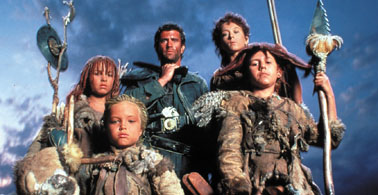
It's hard to praise the third installment of The Mad Max Franchise, because it is essentially a retread of its own now familiar territory. Mad Max is a great character and anti-hero and his journey to stay alive without giving too much of himself to others is an intriguing one. I've read that before starting to plot out The Road Warrior, writer-director George Miller immersed himself in old Samurai and western films. Mad Max certainly fits within those forebearers' walls. In Mad Max Beyond the Thunderdome, he is even briefly referred to as the "Man with No Name," a not so subtle shout out to Clint Eastwood iconic character in Sergio Leone films.

But Mad Max places it's anti-hero in an original backdrop - a post-apocalyptic, gasoline and morally starved Australia whose inhabitants have taken to dressing like punks and renaissance fair rejects.

It's an intriguing setting for action, and it seems that, above all, that is the chief component of the Mad Max series.

When Max is thrust into the gladiatorial Thunderdome of the title, it's a sensational set piece - strange because it is used only once and because it echoes the poorly conceived gauntlets of the syndicated 90s American Gladiator show. Then, echoing the amazing final action set piece of The Road Warrior, director Miller sets the reluctant Max driving away from a horde of baddies on his tail. It's a bit too familiar, but still finishes in grand fashion.

Thunderdome features unique aspects, too. Tina Turner (?!) as the head miscreant rivals Lord Humungous for spiteful power. A little person using a masked brute as his vehicle/bodyguard who starts the film as a odd bully grows to be the more valuable of supporting characters. But most important and entertaining of the new additions is a group of Lord of the Flies/Lost Boys tribal kids who think Max is the one prophesied to take them to their own Promised Land. The scenes with the kids and Max eerily echoes the introduction of the Lost Boys in Hook to the point that my brother was blindly shouting "Rufio" over the action onscreen.

As I said earlier, Mad Max Beyond Thunderdome isn't anything superbly new or exotic when compared to its prequels, but it is supremely entertaining and opens the Max's world to let more imagination in. And though Thunderdome is softer than its predecessors, it is dark and odd enough to rightfully be claimed a part of the Mad Max franchise.

****

Gremlins


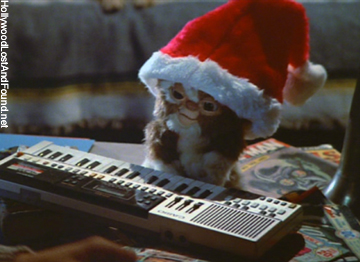
I caught up with this 80s hit this weekend and half enjoyed it. It has some genuine scares. Those little delinquents with bad skin problems are pretty mischievous (what with their murder and vandalism). I think there's a good horror film there, but old mister Speilberg and Joe Dante (with ole Chris Columbus) decide to place the mayhem in Mayberry on Christmas. All scares and frights are dulled by the Norman Rockwell landscape and small town hijinks. Gizmo himself is a fun creation and when the Gremlins, his offspring, are introduced, it's strange and frightening enough to witness. It's when the Gremlins take to smoking a drinking and laughing incessantly in the town tavern that they lose whatever lurid allure that they once had. They're lunch-box villains with bad attitudes. It doesn't help that the human hero played by Zach Galligan has less charisma than his puppet co-stars. It's nice that Columbus and gang nod to their genre influences (homages to Invasion of the Body Snatchers, etc.), but there's not much to take this above a kitch classic.

**1/2

Judge Dredd


There are few times that I will intentionally sit down to watch what I assume is a bad movie. Most of those times stem from the weird fascination with Hollywood disasters - what possessed these people to make these movies at these times? Judge Dredd seemed like just such a disaster, so sitting down to watch it last Saturday (with a sore throat and achy limbs) was an accepted diversion.

It turns out Judge Dredd isn't so bad. It is bad. It is a disaster. But it's not the train wreck that I had hoped for. It clear that Hollywood had inserted its formula in place - take the hero, add a beautiful babe with moxie, add a wise-cracking shlub, and let a dramatic actor run amuck through the film as the villain. Judge Dredd has an interesting central conceit - what if there were citizens acting as the enforcers, judges, and juries on our streets? Put that conceit in a dire and drab post-apocalyptic city and you have a possibility for an intriguing film even when Sly Stallone is your hero.

Instead, the filmmakers go for the faux-blockbuster punch of action and comedy (however slight). Rob Schneider offers the comedic (?) relief, and Diane Lane is the beautiful babe with moxie whose loyalty shows Dredd that there's more to life than the law he had based his life on. Lane shows none of the nuance or subtlety she showed in her Oscar-nominated turn in Unfaithful, though I'll place the blame on the screenwriters and director here.

Remember in the 90's when stars would take roles as villains so they could crazy-ham-it-up and chew the scenery in ways they'd never get away with as the heroes. I'm thinking John Travolta in Broken Arrow/Face Off/Battlefield Earth. Well, take Armand Assante (?!) and give him free reign and you have the worst part of Judge Dredd. As Rico (!?), Assante had never met a scene that didn't need a bit more "pizzazz".

This even distracts from the always wooden Stallone who might actually have been the best example of casting for this film. He looks the part, he grunts the part, now if we could just make the part worth playing...And if we could make the super-Judges plot make sense at all. What exactly is the nefarious councilman's end goal? To make the best Judges ever? Not so nefarious.

**

Saturday, February 28, 2009

100 Female Performances from Popmatters.com

I found this list on IMDB's links of the day. It gives me some ideas for netflix choices.

Monday, February 23, 2009

Yes Man


Yes Man serves as Jim Carrey's return to concept comedy antics ala Bruce Almighty and/or Liar Liar. Liar Liar is a not-so-guilty-pleasure of mine, so I took a trip to the dollar theater with a friend and checked this out.

Yes Man is not as funny as Liar Liar or (I suspect) most of his more successful comedies. It has some charm (mostly from the out-of-place but still sublime Zooey Deschanel) and laughs (Rhys Darby is a hoot doing a take on his Flight of the Conchords character), but is too brisk and simple to make any lasting impression. There simply isn't anything terribly memorable from the movie. When it was over, I had to search deep into my memory to recall why I had guffawed during the movie (it was because of Darby and Deschanel and a neat little role from Terrance Stamp). It's better than most Hollywood comedies, but I must say I enjoy depth with my laughs and introspection from my Carreys. Yes Man has neither.

Highlights - Deschanel sings! Darby theme parties! Carrey and a Persian wife?! Stamp as guru!

**1/2

The Salton Sea

I re-watched The Salton Sea for the first time in 4 or 5 years and really enjoyed it. I thought of my old review on the Wonderreviews site oh so long ago. Rather than writing something new (I'm lazy), I'll post it here:


It's difficult to do anything innovative with the film noir genre. It's hard to make a film involving noirish elements that's not derivative of all the other movies in the vast film noir history. So, taking this into consideration, "The Salton Sea" is all the more impressive. Sure, it follows the path set by other modern film noir pictures, but it's also highly original in its approach to its converging genres. Besides film noir, it also belongs in the "undercover cop in over his head" sub-genre. Add the "vengeful husband looking for his own brand of justice" sub-genre and you've got a melting pot of storytelling techniques. Stir in a who's who cast of character actors playing off kilter characters and you've got something special.

Val Kilmer ("Tombstone," "Top Gun," "Batman Forever") plays Danny Parker and Tom Van Allen, which one he is at the moment escapes him, as he tells in the opening narration. He is playing a trumpet while flames engulf the room around him. It's freaky and kind of unexpected, especially when the opening narrative is more cryptic than informative. But, like most good pieces of the genre, the script is aware that too much too soon can ruin a good story. So, we are introduced into the world Danny Parker has immersed himself in, that of the "tweaker." A "tweaker," as we find out through visuals and Kilmer's narration, is a crystal meth enthusiast/heavy user.

There are several plot twists and exposition devices that can help you understand the plot and make you want to see the movie, but I am wary of mentioning them even though they are mentioned on the back of the video. Let's just go at this in a general, basic sort of offensive.

Danny Parker/Tom Van Allen/Who Knows[?] has inserted himself into the underground tweaker culture in hopes of finding the men who murdered his wife. He was the trumpet playing Tom Van Allen prior to the tragedy, but that part of him died when he embraced the tweaker way of life, even resorting to large body tatoos and body piercings. Tom Van Allen could not watch himself lose himself, so he became Danny Parker because he needed an alias and, presumably, because it's a cooler name. That's the gist of the plot without giving away the twists and turns, of which there are many.

The film dances around time in a manner similar to that of "Memento," although it stays away from the reverse chronology concept. The visuals are gritty and bleached so that everything appears as though its shadows are about to swallow its light. It's a nice visual approach to such a unusual film.

But the real revelation is that Val Kilmer has not forgotten how to act, or for you skeptics, found a way to act. Kilmer is best utilized as a memorable sidekick or playful nemesis ("Tombstone" and "Top Gun"), rather than the leading man roles he often mistakenly takes at the behest of his ego. As Danny Parker/ Tom Van Allen, he shines in a kind of subdued cool role. He doesn't have the catch phrases and nicknames of past roles to fall back on, so he just has to draw it out naturally. Many may say Kilmer drawing cool out from himself is like trying to draw blood from a stone, but he's actually quite cool. It's one of those roles that can turn around a career headed to the straight to video sections of your local video rental establishment (editor's note: he is that straight to DVD guy now).

To make you happy, the viewer is treated to several crazy characters, mainly that of Pooh Bear (expert character actor Vincent D'Onofrio). Also rounding out the cast are Luis Guzman, Deborah Kara Unger, Peter Sarsgaard, B.D. Wong, Anthony LaPaglia, Doug Hutchison, and Adam Goldberg. I realize the list of names by no means constitutes the stars you wanted to see in some movie, but they are all highly talented actors and will not disappoint you.

The best thing about "The Salton Sea" is that, just when you think you know what kind of movie it is, something surprises you. The only problem is a lack of control that director D.J. Caruso exhibits in certain scenes. His attention span isn't quite as short as Michael Bay's, but he does give you the impression that maybe he could have captured some shots with more direction, perhaps more definition. Alas, it still is a fine film with a nose for something new.

***1/2

Wednesday, February 18, 2009

Let the Right One In


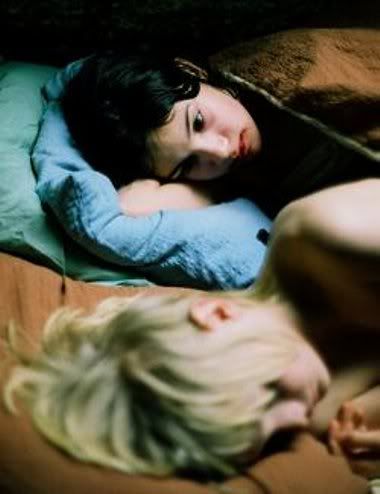
Let the Right One In is the vampire movie Hollywood would be terrified to produce. It's a character piece that moves at a slow pace as to allow its hero and heroine to evolve naturally. It has its moments of terror, fear, blood, and gore like anything Hollywood produces, but it is also content to follow quiet and honest exchanges between preteens. One of them just happens to be a vampire.

It's hard to place a horror movie, especially a vampire movie, into the category of realism, but Let the Right One In is the closest to vampires in the real world as I can imagine. Being a vampire is not cool. None of them are proud of it. It's like a mark of shame that separates them from anyone else except for their own kind. Unlike the more recent of successful vampire franchises, these vampires don't hole up in expensive mansions or live in covens or what have you. The young vampire girl lives with an older (and increasingly less useful) vampire in a crappy apartment building. She goes out only at night and is fearful of any real connection and her need to feed on human life (and apparently vampires have an unpleasant odor).

Calling the style "realism" cannot take away from the artfulness of the film. It's cinematography, acting, and plotting are all expertly conceived and executed. It's a lovely film in the midst of the its own carnage.

What sets it apart, among other things, is the care it takes to tell the story of the friendship and young love between a 12 year boy and the vampire girl. It's adorable and frightening. The quality is in the details that could be easily missed. The young boy's nose is always running. She is always quiet and looks sad and lonely, even after ravaging passerbys. Their connection, like most first loves, is awkward. This isn't a storybook romance. And it is a strange tale. You are likely to feel uncomfortable for some if not all of its runtime. But, as a beginning horror genre fan, I was happy to tag along. Even when the film approaches its sensational extremes, I was pleased to see it end the way it did. As it stands now, it is one of my favorite films of the year.

Appaloosa


I saw this movie with the hope that it would be somewhere between Open Range and 3:10 to Yuma, the two best of the modern westerns (save for the Australian The Proposition). That's kind of a wide gap. Lots of room to fall into. Appaloosa falls behind Open Range and most movies. It's the worst movie I've seen since The Rocker, and this time, I have no excuses for the filmmakers.

Ed Harris and Viggo Mortensen are fine actors. I enjoy both of them. But this script (from Ed Harris and a co-writer) offers nothing special for them to do. The plot seems to aim only for the lows of old Saturday afternoon western movies that played on Akron's worst local station. And it gets there. The only slightly appealing aspect of the film is Ed Harris and Mortensen's friendship (or "bromance" under modern terms). Even that falls short, however, because there are times when these two leads act completely out of logic or reason or accomplish unlikely strange feats. It seems that these two peacemakers and their newly sworn enemy Mr. Bragg (the barely registering Jeremy Irons) are only intimidating in theory. They talk a good amount of smack, but rarely do any of them deliver on their idle promises. In fact, I wonder why Irons took the role at all. There's nothing really for him to do. Except for the short burst of unlawfullness in the first two minutes or less, he is ALL talk.

And I'll only touch briefly on Renee Zellweger here. I must admit that my complaints here are less than objective. In Appaloosa, she's an eye and ear sore. I can't stand any moment she's on screen. I am not one to subscribe to the "Zellweger is inherently awful" theory. I enjoyed her in Chicago and Jerry Maguire and to a lesser extent Cinderella Man. But there is no redeeming quality to her work here. Her character offers nothing to the script save for unearned conflict. No one would fall for this character. No one would risk their life for this character.

And finally, Ed Harris must have cast his entire family or old bocce ball comrades in this movie because the bit players are some of the worst actors I can remember. I cringed every time one of them spoke. The only reason possible for casting such talentless actors must be a sense of duty Ed Harris must have felt.

*1/2