Showing posts with label Why can't we be friends?. Show all posts

Wednesday, October 17, 2007

The Pope of Greenwich Village


The Pope of Greenwich Village is about Charlie (Mickey Rourke) a cool Italian New Yorker trying to get by and move up. The only thing standing in his way is his cousin...his obnoxious, cowardly, big time wannabe, dim-witted cousin Paulie (Eric Roberts). But, hey, he's family, right?

Paulie's the perpetual screw up who doesn't even realize he's a screw up. He screws up and can't say he screwed up. Charlie takes care of him, humors him, and watches out for the guy. One man can only take so much, but Charlie sticks with Paulie because they're not only pals (best friends even) but also family. So, even when the fairly stupid cousin brings a fairly simple heist, Charlie goes in. Turns out the heist wasn't nearly as easy as Paulie made it out to be.

Mickey Rourke was reborn on my TV screen during The Pope of Greenwich Village. There was no more mutant face or smoker's growl. Just charming, smooth, cool as ice though guy Mickey - the way it should be always as never shall be again. There was a time when Rourke was going to be big. Pope was part of that ladder to the top.

Eric Roberts is out of control, let off his leash to run wild. Sometimes that's good and sometimes bad, but it seems that the role was made for show-stopping, scenery-chewing, stand-on-the-tips-of-your-toes theatrics. And in that way, Roberts serves his purpose.

Daryl Hannah played Charlie's girlfriend. She usually bothers me, mostly because I think she looks manish, but she's solid enough in the supporting role.

A problem for the movie is that there are scenes that are too big for everybody's britches - too much music, too much theatrics, too much spiked punch.

However, some scenes are tight. Watching Charlie getting ready to make a big impression and swaying to Sinatra, having a verbal and physical sparring with Hannah, and especially his "Pope of Greenwich Village" moment - all memorable for the best reasons and all involving Mickey Rourke. He never made it all the way to the top. He made sure of that, but it's sure fun to watch him on the way up there.

***

Monday, October 1, 2007

Trainspotting


I must start off this review with a disclaimer:
I am a huge fan of Danny Boyle's work. I tend to use hyperbole when criticizing his work. I am able to find flaws. I don't like The Beach or a Life Less Ordinary.
And so I begin.

Trainspotting is a revelation of sorts for me. I realized I can see a movie in my youth as a disappointment and rewatch it as a treasure. Trainspotting is just such a movie.

I've complained about Ewan McGregor before on this site. I think it started when I reviewed Stay. I claimed he's too over-expressive. In Stay, he certainly was. But he really delivered an amazing performance in Trainspotting as Renton. I think what impressed me was that he was able to play the contradiction of the character so well. Renton is smart enough to see through all the glossy glamor of the drug world and the smiles and cheers of his mates, but he sticks with both. He leaves each. He comes back. Or sometimes each comes back to him. There's a loyalty to the character that can be almost maddening at times. Yet, he is prone to steal, lie, and curse his mates. He knows what he should do. He rattles off a list of answers to his dilemma in a short spark of dialogue at the beginning of the film. All are good reasons to "shape up" (as my mom used to say), but as Renton states, "Who needs reasons when you've got heroine?"

That's kind of the duality of the film. On the one hand, it portrays witty, rag-tag characters enjoying the high life, drugs that is, brick, scag, what have you. Sure, it's hard to watch them stick those needles in their arms, but they sure seem to be having a blast. I laughed. I've been trained to. Stoner comedies are run-of-the-mill now. If movies have taught me anything, it's that stoned people are funny. Trainspotting plays that up for almost half of the movie until the wages of sin become much, much clearer.

Characters talk about how getting high is better than sex. Their reactions don't deny this idea. But it is when they're getting high as a infant crawls around a floor covered in needles that you start to get the point. It's not funny. Even when the most famous scene takes place (where Renton emerges from inside a disgusting toilet triumphantly because he's found the drugs he shat out, I cringed. I really did. I got a bit sick to my stomach. I love the scene. Visually, it's unforgettable. I laughed. It's absurd. But the point of fact is the guy dived into the worst toilet in Scotland to fish out drugs that had been up his bum. Disgusting. The point where the film really switches gear from good times to bad times is when the same infant who had been crawling through trouble dies of neglect. What is the first reaction they all have. Horror. Intense fear. Then they shoot up. No calling the cops, an ambulance, their moms and dads, or a shady alleyman who can dispose of the body. They just sit on the floor waiting for the heroine to cook.

Even though the film portrays this depravity, it never really completely lets go of its humor. Horrible visions are counteracted with laughs in later scenes. I'm not sure whether to applaud or admonish that, but I do know I would have cried myself to sleep without it. And like Danny Boyle is prone to do, the film manages to end on a lighter note than the misery that proceeds it. A character promises he's going to be better, stop messing up, and make things right. I smiled, but all along I knew he'd be right back at square one soon enough. So, the movie provides the smile, but doesn't trick anyone. I don't think it tries to.

I enjoyed the acting. McGregor, Johnny Lee Miller, and Ewen Bremner have never been better. I also enjoyed seeing Kevin McKidd as Tommy. His character begins saying that a high is better than sex, but later in the movie his eyes betray his words as he becomes stricken with AIDS. Watching Robert Carlyle at work as Begbie is exhilerating mostly because he was shocking, crazy, interesting, scary, and funny at alternating times, though I never knew which Begbie would jump out at me at any given second. It's a performance that is ripe for showboating. I can't really excuse Carlyle from falling into that trap, but he can be brilliant in the role when he wanted to.

And ole' Boyle. Now I shall praise in hyperbole. The man knows how to carry humor into the depths of despair and fear. Visually, he always makes interesting movies. Trainspotting is no expception. Fans still talk about dozens of shots for a reason: the cinematography and creativity visually are stunning and instantly memorable. As far as handling his actors, he let Carlyle go a bit too much, as evidenced in his interview on the DVD. I also think he found a good tone with the humor. I laughed a lot out of nervousness, and I think that's a hard reaction to earn justly.

I'm a fan. It's an excellent movie. Cheers, mates!

****
Friday, September 21, 2007

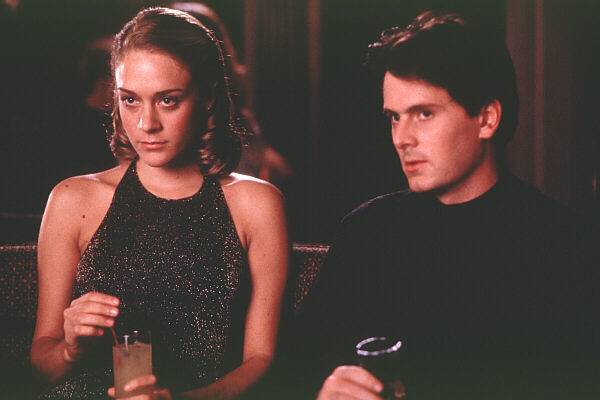
The Last Days of Disco


The pleasure of watching a Whit Stillman film is not reliving my past or seeing my future. The youth he portrays in his films is very different from mine. I am not bourgeoisie. I am not in love with disco. I am not from a rich family. I have not read many facinating books. I am not like the characters depicted in these films (Barcelona, Metropolitan, The Last Days of Disco), well, not really. But I recognize these types. I know people, you know? And the realities of the people in Stillman films are not all that different from the realities of people I know, and, well, me too. I admit. I'm like these Disco lovers. There is wonderful pleasure in watching Whit Stillman's work.

Like the group of revolving friends and lovers in The Last Days of Disco, I too have experienced the need to fit in, or in the case of these characters, getting in. They're too self-absorbed to realize that the place they want to get and stay in - the place where they have fun, dance, drink, fall in and out of love, be good friends, and be bad friends - is dying. Disco and this club that they frequent symbolizes the folly and seriousness of youth. And not adolescence. Not being in college. Like few filmmakers, Stillman has a keen sense of the way post-college feels (or what I imagine it feels like). Along with other film's depictions of youth, The Last Days of Disco portrays the urge to fill others expectations of you, or maybe to change how others see you, or maybe even to change the way you see yourself. All of the above. None of the above.

The truth is, these characters only flirt with change. They approach it, but like one character says about the Tramp of Lady and the Tramp, no one really changes. Their context can change, but people never really do. It's a cynical view of society, but the film backs it up.

A Stillman staple is a witty, sophisticated banter/dialogue between characters. What's intriguing is that I've never really heard people in real life talk this way. Even the most mundane, accidental conversation seems planned. But it's never forced. And somehow I believe it. Somehow the reality and truth always shines during even the most artifical scenes.

Sample witty dialogue: Des McGrath: "Yuppie stands for 'young upwardly mobile professional'. Nightclub flunkie is not a professional category. I wish we were yuppies. Young, upwardly mobile, professional. Those are good things, not bad things."

The Last Days of Disco is Whit Stillman's best film. Not only does he guide his best cast to date, but his organization and handling of the distinctive personalities of the film's multiple characters is amazing. Each is complex. Each is real (you know, in that sort of artifical way I semi-explained earlier). And though his other films showed a insight into the life of the privileged, he has never before so accurately displayed an atmosphere. Apparently, Disco was contagious. I never got it before. "Disco?" I asked. "Ugh! Yuck!" I shouted. But it looks like fun. There, I said it. "Disco looks like fun."

****1/2

Wednesday, August 22, 2007

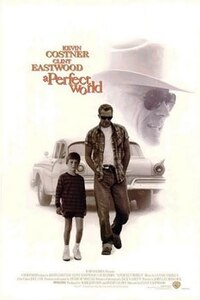
A Perfect World


I must say that I loved parts of this film. The majority of the scenes between Costner and the young boy were very interesting and unique. The strange dynamic of the ole Stockholm's syndrome takes effect, but the reasons behind it are what make it so interesting. It's also interesting because it takes place with a criminal on the lam and the young boy he took from his house for the ride.

Costner has that reputation for being a bland actor, but I enjoy the guy. I love Field of Dreams. I enjoy Dances with Wolves and so on. I've seen him in bad movies. I've seen him be bad in bad movies. But seeing him as a good/bad guy in A Perfect World gave me new respect for the man as a performer. It's a very good performance, perhaps his best. I marveled how the writer, director Clint Eastwood, and Costner pushed and pulled the audience in relation to Costner's character. He's frightening at first, being a criminal with a gun and all. However, the audience can see he's not all bad as he keeps his accomplice in check from committing the mayhem that character seems destined to commit. Then he takes the kid under his wing, playing the father and the friend when it seems his character never had one before, never a good one anyway. I warmed up to the guy. He seemed good enough. Then, as soon as my comfort with the character had been cemented, the filmmakers choose to make me frightened again and wary of how easily I had been charmed. That choice ends up getting out of hand a bit, but I was impressed with the skill it took to make and start to execute it. I'll get to that moment later.

I like the way the movie incorporated a lost boys type attitude to the main characters - Costner's Butch and Phillip the boy. Each was a man lacking in a father's loving touch. Something that seems so obvious, so straight-forward ended up constructing such interesting characters. You cannot say otherwise when it comes to Butch and Phillip.

There were things that bothered me, namely Clint Eastwood's character and his law enforcement gang's pursuit of Costner's character. I never found that storyline interesting. It was full of Clint Eastwoodiness. He just was so grizzled, cranky, old and wise, tough, but sweet natured under it all that I got a little bored in his scenes. I've seen him do it before. It seems that for the last fifteen years or so, that's all the veteran actor does. I understood the storyline as being a key way of revealing things about Costner's character and his past in a naturally occurring way, but I didn't really get involved in it. I didn't really invest myself in any of those characters that included Laura Dern's.

Another thing that bothered me was the hijinks moments. Some interactions were funny, good-humored bits of time. Others were too light to be in this kind of movie. I half expected for the old The O.C. hijinks music to start pouring through my speakers. That's not a good thing. Clint Eastwood's storyline gets the bulk of the hijinks that allow him to show off his typical aforementioned character traits.

And that ending. That's what I mentioned earlier. It goes on too long. It starts out with a bang - great tension, higher stakes, a bit of exciting character twists, and so on. But then it keeps going. Clint Eastwood shows up with his law enforcement gang and they get to muck it up. The somewhat overly dramatic catalyst at the end in what seemed justifiably dramatic is a head scratcher. The scene was set up for a big finish that would propel the film into memory and provocation of emotions, but Eastwood punches it too much. I never really pegged him as a subtle actor or director (and I like him as both in most) but I don't think I expected him to let it get so out of hand. It goes on too long, it involves a punch line from his character in a moment utterly lacking in humor, and so on.

But I would watch it again, if for no other reason than to spend time with Costner and the boy on their trip to friendship together. It sounds corny, but it was a thoroughly entertaining one.

***

Sunday, August 19, 2007

Once


Once is a charming backstage musical of the indie kind.

The story is ultra-bare. Basically two musicians meet-cute and dance around their attraction for each other as they talk about past loves while making beautiful music together. The film is really short (less than 90 minutes), probably because it could tell its story in a short amount of time well.

I was talking to my brothers on the way home from the movie about how the characters had so much subtext in their conversations and interactions. But there is still so much mystery to what their intentions are. Are they falling in love. I thought so. But I didn't know. That's key. I knew very little about the characters, probably because the characters don't know that much about each other or their intentions. I did want to get to know them better. I sort of wanted to spend more time with them. I liked them enough to feel that way. I wanted them to get together.

I was disappointed in the direction their lives took, but I was thankful for the time I spent with them and the genuine moments I spent with them and their music. I was thankful that somehow I was satisfied by the wonderful ending although it was different from the way I expected it to end. I was thankful people get to make deeply personal films like this and show them to me in small theaters with other thankful audience members. It's a bittersweet story about two people figuring their lives and each other out.

I will say that I wasn't totally convinced by the acting. The characters and performers are charming, but there is some noticeable hints of these musicians learning to act.

****

Friday, June 29, 2007

Shallow Grave


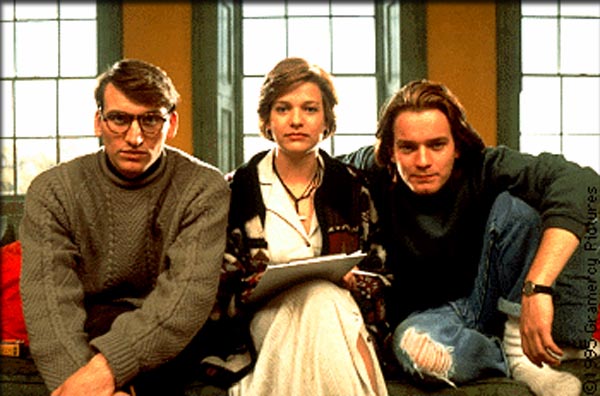
I fear I may have spoken too quickly of my disappointment in Ewan McGregor’s range as an actor. I say this because I recently rewatched Danny Boyle’s first film, Shallow Grave, and found McGregor to be quite capable in his role. The character still allows McGregor to display his charm, starry-eyed wonder, and expressive inflection of the lines written by Trainspotting screenwriter John Hodge.

Shallow Grave somehow got more taut, more scary, and more clever during my second viewing of the film. The performance by the leads (Kerry Fox, McGregor, and Christopher Eccleston of 28 Days Later fame in one of the creepiest performances in my memory) were very good and benefited from a brilliant chemistry between the performers.

Basically, a bag of free money is never free (see A Simple Plan if you doubt me). I am reminded of a great quote from a bad movie, 8mm: “If you dance with the devil, the devil don't change. The devil changes you.”

Boyle again shows a knack for visual inventiveness and ability to organize thrills in a expert manner. He truly is a master. Even when the script and actors are out to lunch, he’s always doing good work from the director’s chair.

A taste of the wit of the script: [Juliet, Alex and David are about to dispose of Hugo's body by rendering it unidentifiable]
Juliet Miller: “I can't do it. “
Alex Law: “But Juliet, you're a doctor. You kill people every day.”
John Hodge put together a basic thriller that excels in practically every way. Even a twist that should be seen a mile away is surprising and fun. He writes the disintegration of friendship and morals very well.

***1/2