Wednesday, October 17, 2007

Ordinary People


For the longest time, the only time I heard about Ordinary People was when people mentioned that it robbed Raging Bull of Best Director and Best Picture Oscars in 1980. Then I saw Timothy Hutton in Beautiful Girls a while back and tried to find out what he's all about. Turns out he won a deserved Best Supporting Actor Oscar in 1980 for Ordinary People. "Huh," I said. "I oughtta see that." And now i finally have.

Ordinary People is a film boiling over with emotional truth. The ordinary people of the title are relatable. I could know them. I could be them. I certainly saw parts of myself in characters.

The film is about a family struggling to connect and keep a sense of normality after the accidental death of one son and the attempted suicide of another. That's enough to make any family crack. And they certainly do.

Hutton plays the son, Conrad, who attempted suicide. The film starts as he is going back to school at the beginning of a new school year. He received the Oscar for a supporting role, but his story anchors the entire film. He carries it. Everybody else helps, but he shoulders the best of it.

He delivered a big, bright, and amazing performance. Somehow he was able to stare blankly at nothing and convey an avalanche of thought behind his eyes. His awkwardness and anger in therapy scenes with Dr. Berger (Judd Hirsch) were accurately and believable performed. What really struck me in those scenes was the details he put into inflection, stops and starts, and change in emotions that were impeccable.

Hirsch played the dream psychiatrist, one who pulls you through your reluctance and resistance to a place you could never have reached on your own. It might be a movie myth - this amazing type of psychiatrist. But it certainly works in Ordinary People.

I liked that the love story between Conrad and a co-ed (Elizabeth McGovern), although helpful and ultimately rewarding, was shown as a brief interruption from troubles, but ultimately not the answer. A lesser movie would have made the journey to revelation for Conrad be with his girlfriend and not his psychiatrist.

Conrad's parents are a mess. They're able to fake pleasantness and stability, even happiness, but it's all just an escape from all the shit that keeps happening around them. The father Call, played by Donald Sutherland, is attempting to address the hardships head-on. The mother Beth, played by Mary Tyler Moore is trying to get over it all and get on with their lives.

The parents are a flip on conventional parental and gender roles. Cal is worried, nurturing, loving, and supportive. Beth is emotionally distant and/or callous, and wants to gloss over the past in favor of a happy future. This displays a characteristic common to all the characters and performances. They are all complicated, layered, and detailed.

I've never seen Sutherland like this before cautious, questioning, contemplative. And his work as a father fits him well. It's hard when an actor's been around so long that and the young people (myself and contemporaries) are only familiar with his work in Outbreak, The Italian Job, and The Puppet Masters. He's good.

Moore is amazing in this role. It's the performance of a lifetime. Her Beth is complicated and maddening but still sympathetic somehow amongst all her transgressions. When her characters was finally revealed as weak, the revelation clarified everything that preceded it and acted like a magnifying glass on Moore's perfect gift for imperfections.

Robert Redford directed the movie and handles his performers exceptionally well. His handling of flashbacks and memories was less successful. The echoed voices, the fuzzy outlines, the quick cuts - it's all too conventional and too showy for a movie that is able to understate other big themes and performances so well.

This movie was like therapy for me. The aftermath of a suicide attempt is familiar. The loss of control. The way others handle you with kid gloves that bothers ya', or bothers ya' when they don't. And most familiar was the struggling with what confronting real, raw, and honest emotions will mean. Ordinary People does it all so well.

Good Will Hunting and American Beauty owe debts to Ordinary People. They didn't steal from it, but they still owe a lot.

****

The Pope of Greenwich Village


The Pope of Greenwich Village is about Charlie (Mickey Rourke) a cool Italian New Yorker trying to get by and move up. The only thing standing in his way is his cousin...his obnoxious, cowardly, big time wannabe, dim-witted cousin Paulie (Eric Roberts). But, hey, he's family, right?

Paulie's the perpetual screw up who doesn't even realize he's a screw up. He screws up and can't say he screwed up. Charlie takes care of him, humors him, and watches out for the guy. One man can only take so much, but Charlie sticks with Paulie because they're not only pals (best friends even) but also family. So, even when the fairly stupid cousin brings a fairly simple heist, Charlie goes in. Turns out the heist wasn't nearly as easy as Paulie made it out to be.

Mickey Rourke was reborn on my TV screen during The Pope of Greenwich Village. There was no more mutant face or smoker's growl. Just charming, smooth, cool as ice though guy Mickey - the way it should be always as never shall be again. There was a time when Rourke was going to be big. Pope was part of that ladder to the top.

Eric Roberts is out of control, let off his leash to run wild. Sometimes that's good and sometimes bad, but it seems that the role was made for show-stopping, scenery-chewing, stand-on-the-tips-of-your-toes theatrics. And in that way, Roberts serves his purpose.

Daryl Hannah played Charlie's girlfriend. She usually bothers me, mostly because I think she looks manish, but she's solid enough in the supporting role.

A problem for the movie is that there are scenes that are too big for everybody's britches - too much music, too much theatrics, too much spiked punch.

However, some scenes are tight. Watching Charlie getting ready to make a big impression and swaying to Sinatra, having a verbal and physical sparring with Hannah, and especially his "Pope of Greenwich Village" moment - all memorable for the best reasons and all involving Mickey Rourke. He never made it all the way to the top. He made sure of that, but it's sure fun to watch him on the way up there.

***

The Spanish Prisoner


Slights of hand, trickery of the verbal, visual, and plot kind - must be Mamet. But wait! What's this?! PG-rated Mamet?! This cannot be! Surely the sizzle and grit is gone. But no. The Spanish Prisoner is actually quite good.

The film follows Campbell Scott, a inventor of sorts, whose character has created something that will make the company he works for a lot of money. Keeping his hands on the secret seems easy enough. Should be.

I watched the first 45-60 minutes of this movie wondering what I was watching. I couldn't categorize the film, not because I couldn't follow it. Rather, I had no idea where the plot could or would go.

I should say that I was able to figure out where. And I knew what kind of movie it was. I started out thinking it was like an Alfred Hitchcock movie - maybe The Man Who Knew Too Much. Then I realized I was going about it all wrong. The Spanish Prisoner should be filed under Mamet in the video store, cause it has his handiwork written all over it.

That's both good and bad. Like I have noticed in his other movies (Heist and Spartan specifically), he pulls the wool over your eyes but leaves a peep hole. You get tricked, but the real trickery is making the trickery so obvious that you miss it anyway. I started to think, "That's not all that smart. It's simple, really. Maybe too simple." But that's the genius of Mamet - too simple to be dumb. Does that make sense? He plays your judgments against you. Trying to figure out what's happening only makes you miss things you should have been paying attention to.

If Mamet's struggled at his own game, it's most apparent in The Spanish Prisoner. The problem isn't that he didn't take me for all I'm worth. He did. He got me fair and square. The problem is that he was too obvious this time around. He made specific reference points stick out (WAY out) in front of the audience. He said "This is important! Remember this!" So I did. In that way, he makes his most accessible movie. No one's gonna get lost. It's all there. The audience can jumble things around, question themselves, but still figure it out long before they're supposed to. I know I just said he got me. The thing is that any number of people could have paid enough attention to be on the up and up the whole way through. It's not hard. I'm just the kind of guy ripe for the fooling. That's not Mamet's fault. It's mine. His problem is over accentuating the clues.

I praise and criticize Mamet for the same thing. I must be out of my mind, right? A little. Happily, Mamet challenges me. He's always successful, but he doesn't always go about it the right way.

Other things - his handling of the end was soft. Satisfying, but only because it wrapped things up, not because the dialogue was Mamet-sharp or even all that convincing. It winds up in a fashion not above that of a TV movie or Law and Order.

I am a HUGE fan of the first two acts. Yahoo! Write-it-down-in-love with the first two acts. But that last act, which I can certainly tolerate, brought me down off my high.

Campbell Scott - good. Steve Martin - solid. Rebecca Pigeon - so so. And that's the thing. Mamet could have casted dozens of more accomplished and more talented actresses than his wife. I like Rebecca Pigeon. I even liked her in this movie. But she ends up just being okay. And she kind of blows her part in the last act. I loved her and she was good in State and Main, but if I'm honest with myself, Mamet can do better...you know...casting wise.

I know this review is confusing. I'd like to say that was on purpose to try to play off some of the same slight of hand Mamet uses, but it's just because Mamet drives me crazy. For better or worse.

***1/2

Monday, October 15, 2007

Stranger than Paradise


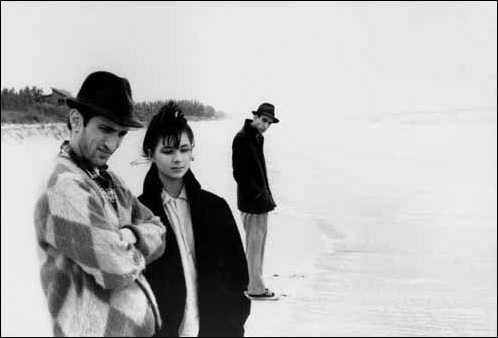
Stranger than Paradise lives up to its title. It's strange all right. It's like an impenetrable, boring, morose, deadpan strange trip to Cleveland, New York City, and Florida. And that be exactly what writer/director Jim Jarmusch was going for. If so, Bravo! Still, the film left me wanting ol' Roberto Benigni from Down by Law to waltz in with his zaniness and liven up the joint.

Instead, I got the droll, monotone comedy and silence of John Lurie, Eszter Balint, Richard Edson. Lurie plays Willy, whose cousin Eva, played by Eszter Balint, from Hungary comes to visit during a stop on a trip to Cleveland, Ohio. When she leaves, a year passes before Willy and his pal Eddie, played by Richard Edson, drive out to Cleveland and rescue Eva from a cold winter and boring nights at home with Willy's aunt (a deadpan, monotone, very foreign, and funniest performance by Cecillia Stark). When they get to Flordia, they discover Florida isn't the Paradise they expected it to be. A series of comical miscommunication and misunderstandings follow.

John Lurie is an actor I'd prefer not to see in movies again. He is as bland as they come. Even when conveying emotion, he's lifeless. Any laughs from the film are hard to come by because the comical moments are so underplayed that it's hard to know if they're even supposed to be funny. So, instead of natural reactions of laughter, I did a lot of head scratching trying to figure out if things were funny or if I just needed to find something to laugh at to keep me going. Lurie is the chief culprit, but Jarmusch writes and directs moments engineered for this strange ambiguity of appropriate reaction.

Most of the time, my reaction was just looking at sometimes beautiful black and white cinematography and freeze framing shots in my mind (or literally with the pause button).

Like Down by Law, I don't really get the point or points if any that Jarmusch is trying to make. If his point is just to entertain, he failed me.

I can say that there is a big improvement from Stranger than Paradise (his first movie) to Down by Law (his next movie after that). I can only hope that if I see enough of his movies, his work might eventually improve to a completely enjoyable experience.

**

Sunday, October 14, 2007

Paris Je T'aime


Paris Je T'aime is an anthology of short film love letters to Paris. Each of the film's 18 shorts deals with love with Paris as a setting. Some of the world's premiere directors filmed a short for the anthology including the Coen Brothers (Fargo, O Brother Where Art Thou), Alfonso Cuaron (Children of Men, Harry Potter and the Prisoner of Azkaban), Gus Van Sant (Good Will Hunting, Elephant), and Alexander Payne (Sideways, Election).

Each of the short films is only about five or six minutes (and seem shorter), so I had difficulty at first because I spent such little time with characters before the next story would begin. I began to feel at ease when some of the directors took special care when constructing their stories with beginning, middles, and ends in a more traditional sense.

I felt a wide range of emotions while watching the short films. For the most part, I felt truly satisfied by each segment, though some were much more successful than others.

I liked how the films were able to take an idea like love in Paris and stretch it more than just falling into romantic love. Some people narrowly missed love, lost it, or lost it and then regained it. There was also familial love, love for life, and love for Paris itself.

I was impressed how well some of the directors told their stories. I was continually amazed by how many films were able to surprise me in such a short amount of time. Just when I thought their narratives were going in one direction, they zig-zagged a different way.

Some of my favorite segments were Faubourg Saint-Denis by Tom Tykwer (Run Lola Run) about a blind man's recollection of fleeting love found quickly again, Quartier de la Madeleine by Vincenzo Natali about a giving of self for love for a vampire, and Place des FĂȘtes by Oliver Schmitz about a dying man making one last attempt to charm a beautiful woman who has eluded him.

Not all the films are good. I did not take to Porte de Choisy by Christopher Doyle about a salon products representatives dream hair appointment, or Parc Monceau by Alfonso Cuaron about a father and his daughter talking about old habits and new trials. Neither film handles the time frame well. Porte de Choisy tries to fit too much all at once into its tiny run time, and Parc Monceau does not do enough with its run time.

That proved to be the deciding factor in determining the quality of the segments - How well did they entertain or captivate their audience in the amount of time they had? How did they structure their shorts? What were they trying to do, and did they accomplish that?

More often than not, Paris Je T'aime sweetly and sometimes sadly told short stories that will last much longer in my memory.

***1/2

Across the Universe


Across the Universe is one of the worst films that I have seen in the theater in a long time. It is a mess of a movie.

The film follows a rag tag group of young people during the turbulent 60's. Our protagonist is a English lad named Jude. He goes to America to find his dad, but stays after meeting Max and his sister Lucy. Lucy and Jude are destined to be entwined in young love.

That's really the story. It is as thin as a paper cup and just as disposable and recyclable. Everyone who has seen a movie about the 60's has seen this plot or elements of the plot before. It tries to touch on everything - hippies, music, the civil rights movement, and the Vietnam War and the struggle of the "radicals'" protesting at home among every other instance of 60's nostalgia you can imagine.
The characters are also 60's stereotypes masquerading as memories.

The problem is the filmmakers love The Beatles (whose music makes up the entire musical's soundtrack) too much. The story exists because of the songs, not the other way around as it should be. The story is thin because it merely bides its time with a loose narrative as an excuse to fill time between musical interludes. Those small pieces of narrative cannot sustain the audience's interest, so the filmmakers chose to make the time in between songs short and forgettable so we can push right on through to the next number.

Some of the musical pieces serve as bold interpretations of The Beatles musical catalogue and contain interesting images, but most stick out like sore thumbs in the context of the narrative. A few of the musical numbers did stand out as quality pieces of filmmaking including "Let it Be" during race riots, "Strawberry Fields Forever" in a Vietnam and artist freak out montage, "Across the Universe" on a subway car, and "Because" lying in a field of tall grass.

Still, the film has no subtlety in its purpose: to use as many Beatles songs as possible. That means having characters named Jude, Lucy, and Prudence. Max might as well been named "Eleanor Rigby" to keep the trend going.

Certain things bothered me above all. There was use of a heightened reality common to film musicals, but that was no excuse for a lifeless and bland film in the midst of all the vain attempts to shower the audience with vibrant life. I have never seen a better example of style over substance.

Another annoyance was the love story. I could not be invested in the two lovers' fates at all. Perhaps I have been spoiled by the recent indie musical Once with its wonderful characters and lovely love story. The big deal is that the love story is really the meat and potatoes of the narrative. If I could not care about the love story, I was doomed to not care about the whole movie.

The film did manage to find some level of balance and relative skill in the third act, but by then it was too late. I was turned off by the movie early on and had no hope for reinvestment.

*1/2

Michael Clayton


Michael Clayton is a top-notch legal thriller from the mind of writer/director Tony Gilroy (he of the Bourne franchise fame). I sat down in my theater seat expecting a solid movie, but what I got was one of the best films I've seen this year.

Michael Clayton (George Clooney) is the protagonist of the title. He is a man down on his luck and searching for a way to keep his head above water after a bar business never gets off the ground. He is a reforming gambler. He is also the go-to "janitor" of one of the biggest law firms.

A janitor is a lawyer who cleans up other lawyers' and clients' messes. He does not go to trial. His job is to make sure everything is not a disaster by the time the transgressions go to trial or avoiding trial altogether.

His current dilemma in the movie is fixing the ruins after one of his colleagues and friends strips naked at a deposition in a three billion dollar lawsuit against a major farming corporation.

It seems that Clayton's friend, played with manic fear, energy, and sparkle in his eyes by former Oscar nominee Tom Wilkinson, went off his medication around the time he had a mental breakdown/epiphany that threatens to destroy the case. Clayton is sent in to do damage control.

The threat is looming over chief council for the corporation played with nervous energy by Tilda Swinton. As she loses hold over the case, she struggles to contain the damage in more questionable ways than Clayton is pursuing.

It seems everybody is unhinging. As Clayton learns more and more about the case, he watches more of his professional and personal life unravel around him. The real mystery of this thriller is not who is going to get hurt or who is at fault for inflicting the damage, but rather what kind of man Michael Clayton is. He becomes faces with a crisis of conscience, which is especially difficult for someone whose conscience has been pushed into the background for so long.

Unlike the John Grisham thrillers that every critic seems to compare Michael Clayton to, Michael Clayton does not use one shred of heavy-handedness or exploitation of its genre conventions. Instead, the film boils slowly at a deliberate pace. Still, I was amazed very early on how tight the film's plot was. There is not an ounce of fat on it.

That is because the film's exposition and characters develop slowly at a natural rate of revelation. Nothing is rushed or forced. Every little detail begins to matter. Not in the way a mystery unravels, but in a way that the details tie together motives, morality, and world of the characters.

Clooney and Wilkinson deliver Oscar-caliber performances in Michael Clayton. Their scenes together burst with tense verbal fireworks. Gilroy and the actors are aware of the necessity of good characters.

Clooney especially gets to display some of the intensity he showed in his Oscar-winning role in Syriana two years ago. He is at his best handling heavy dialogue with either intensity or cool levity. The former is the case here. He does not disappoint.

Eventually, the film culminates in a showdown too simple and familiar to satisfy my growing love for the film. However, it follows suit with the importance of details. Everything before it leads to the finale. Still, the script, which had been so effortlessly smart and fresh throughout, showed a bit of strained effort at the conclusion.

It is still a tad early to be making top ten lists for 2007, but I would not be surprised if Michael Clayton makes its way onto mine.

****

Thursday, October 11, 2007

Kaze no tani no Naushika (U.S. Title - Nausicaa of the Valley of the Wind)


I've been wanting to see this movie for a while. I saw the DVD at Best Buy and almost pulled a blind buy, but the cost was too high for such a maneuver. I tried to find it to rent around the area, but to no avail. I looked it up on Google Video and was surprised to see that the whole movie was up for viewing (probably illegally). And so, for the first time, I watched a movie illegally. And I don't feel all that bad. I'm asking for the DVD for my birthday. So everybody wins. Everybody wins!

Nausicaa of the Valley of the Wind reminded me a lot of Princess Mononoke. Each features one wise person preaching the saving of the environment from rulers bent on destroying it. Both plots balance action with quiet conversations amongst the wild and within towns and villages. And both are really good. Princess Mononoke gets my pick over Nausicaa, but both rule.

Nausicaa is considered to be the first of the Studio Ghibli films. That's particularly interesting because Nausicaa is much more like Princess Mononoke than other 1980's Studio Ghibli films even though the two films were released 15 years apart from each other. Still, the Miyazaki animation style is present. The detail and beauty of his hand-drawn art is breathtaking. I've noticed that he animates smoke and fire better than any other animator than I've seen. There's something so distinctive about his style that makes his films' look and storytelling unique, which is a pleasure amongst the now standard Disney animated fare (still...goooooo Pixar!).

The story is basically that the world is overwhelmed by a toxic vapor emanating from the jungle where giant deadly insects rule. Chief among the insects are slug/snail, caterpillar/what-in-the-world-looking behemoths who transform from docile eyesores into raging runaway trains at the drop of a hat. It seems that only one person can calm these creatures, save her people, bring peace to the land, and learn the secrets to the preservation of her world. That person is Princess Nausicaa.

Princess Nausicaa is a refreshing heroine. She possesses many characteristics that make her a good role-model - determination, strong leadership, wisdom, strength, love, courage, and much more. What a gal! I was reading on Wikipedia (the famous beacon of truth) about how a U.S. version titled Warriors of the Wind was released in the 80's with a poster/VHS box art featuring male characters that appear only briefly or merely as supporting characters. And there was Princess Nausicaa, the true protagonist and great character as a background afterthought. Rotten, no good, boy-centric-programming 80's!

A major plus was some swell aerial action scenes that were smooth poetry and excitement. Its a blast to watch complicated movements and details flow perfectly across the screen. It's a bummer to think that movies like this (immaculate hand-drawn animation) will be non-existent soon enough. That's why it's really worth checking out Miyazaki's films even if you find the pacing boring or the stories strangely childish though told ultra-seriously.

Some things that bothered me included some of the hijinks humor that I have found to be common in Miyazaki's films. Presumably this is because these films are created for children, but I can't really imagine any kids being able to pay attention to Nausicaa of the Valley of the Wind long enough to get a kick out of it. Still, I might be selling today's kids short because I can only speculate that I wouldn't have been able to sit still through the 2 hour run time at age 9 or 10. I've also realized that some of the zaniness of the hijinks and humor can be cultural specific. After all, all Miyazaki films premiere in Japan way before American eyes ever see a frame.

***1/2

Monday, October 8, 2007

Down by Law


Down by Law is still walking around in my brain. I saw it last night. I'm still deciding how I feel about it, so this may end up being a stream of consciousness review when all is said and done.

I think I liked it. It definitely did not possess the usual attributes and qualities I look for in a film, especially independent film. It's atmosphere is pretty bare. Jarmusch creates a stale air speaking "Louisiana, Louisiana" and "jail, jail." I can't really put my finger on it more than that.

I felt distanced from the film and the characters for most of the film. There were times when they opened up or had a brief spell of interaction that was mildly amusing, but there was also a lot of bland waiting and silence. It can surely be said that silence can say a lot, but I don't think the silence in Down by Law said that much. More accurately, it said what it had to say and then kept repeating it over and over again.

Of course, whenever you add Roberto Benigni to the mix and you get more interest and excitement than whatever you had before. he adds life and mischief to the film. The best moments in the film - and there are several really, really good scenes - take place after Benigni joins the other two characters in their jail cell. I'm not particularly a fan of Benigni, but I am impressed by how his mere presence in Down by Law made the film and the other two main characters interesting.

Jarmusch employs a leisurely pace. He certainly doesn't rush things. At times, he tried my patience. Other times, especially when the three main characters were on the lam, he kept me engaged (for the most part).

Since this is only the second Jarmusch film I have watched all the way through (the other being Ghost Dog: The Way of the Samurai, which employed a similar leisurely pace), I can only really speculate here...but I think Jarmusch is still trying to find his voice in Down by Law. He doesn't really say that much in the film. And what he does say, he doesn't say well. I might be looking for meaning in all the wrong places, but it seems he was really just making a dark, bleak, sometimes zany comedy about casual friendships and the long arm of the law. It also moves along the lines of a tough-love letter to the seedy streets, back alleyways, back woods and swamps of Louisiana.

I had a love-hate with the cinematography. On the one hand, the black and white images on screen could be beautiful. Black and white lends itself to beauty. But the camera was stationary or static for many shots. This added to the stale air. It must be difficult to film a jail cell and make it interesting, but Jarmusch didn't even try. If his intention was to show the boredom of jail, he succeeded. As a setting for a film, I think that setting has to be visually interesting for the audience.

I'll give this movie a marginal recommendation, though I do want to see Down by Law to see if I missed the point along the way the first time. I also look forward to seeing what ol' Jarmusch has up his sleeve.

***

Monday, October 1, 2007

Trainspotting


I must start off this review with a disclaimer:
I am a huge fan of Danny Boyle's work. I tend to use hyperbole when criticizing his work. I am able to find flaws. I don't like The Beach or a Life Less Ordinary.
And so I begin.

Trainspotting is a revelation of sorts for me. I realized I can see a movie in my youth as a disappointment and rewatch it as a treasure. Trainspotting is just such a movie.

I've complained about Ewan McGregor before on this site. I think it started when I reviewed Stay. I claimed he's too over-expressive. In Stay, he certainly was. But he really delivered an amazing performance in Trainspotting as Renton. I think what impressed me was that he was able to play the contradiction of the character so well. Renton is smart enough to see through all the glossy glamor of the drug world and the smiles and cheers of his mates, but he sticks with both. He leaves each. He comes back. Or sometimes each comes back to him. There's a loyalty to the character that can be almost maddening at times. Yet, he is prone to steal, lie, and curse his mates. He knows what he should do. He rattles off a list of answers to his dilemma in a short spark of dialogue at the beginning of the film. All are good reasons to "shape up" (as my mom used to say), but as Renton states, "Who needs reasons when you've got heroine?"

That's kind of the duality of the film. On the one hand, it portrays witty, rag-tag characters enjoying the high life, drugs that is, brick, scag, what have you. Sure, it's hard to watch them stick those needles in their arms, but they sure seem to be having a blast. I laughed. I've been trained to. Stoner comedies are run-of-the-mill now. If movies have taught me anything, it's that stoned people are funny. Trainspotting plays that up for almost half of the movie until the wages of sin become much, much clearer.

Characters talk about how getting high is better than sex. Their reactions don't deny this idea. But it is when they're getting high as a infant crawls around a floor covered in needles that you start to get the point. It's not funny. Even when the most famous scene takes place (where Renton emerges from inside a disgusting toilet triumphantly because he's found the drugs he shat out, I cringed. I really did. I got a bit sick to my stomach. I love the scene. Visually, it's unforgettable. I laughed. It's absurd. But the point of fact is the guy dived into the worst toilet in Scotland to fish out drugs that had been up his bum. Disgusting. The point where the film really switches gear from good times to bad times is when the same infant who had been crawling through trouble dies of neglect. What is the first reaction they all have. Horror. Intense fear. Then they shoot up. No calling the cops, an ambulance, their moms and dads, or a shady alleyman who can dispose of the body. They just sit on the floor waiting for the heroine to cook.

Even though the film portrays this depravity, it never really completely lets go of its humor. Horrible visions are counteracted with laughs in later scenes. I'm not sure whether to applaud or admonish that, but I do know I would have cried myself to sleep without it. And like Danny Boyle is prone to do, the film manages to end on a lighter note than the misery that proceeds it. A character promises he's going to be better, stop messing up, and make things right. I smiled, but all along I knew he'd be right back at square one soon enough. So, the movie provides the smile, but doesn't trick anyone. I don't think it tries to.

I enjoyed the acting. McGregor, Johnny Lee Miller, and Ewen Bremner have never been better. I also enjoyed seeing Kevin McKidd as Tommy. His character begins saying that a high is better than sex, but later in the movie his eyes betray his words as he becomes stricken with AIDS. Watching Robert Carlyle at work as Begbie is exhilerating mostly because he was shocking, crazy, interesting, scary, and funny at alternating times, though I never knew which Begbie would jump out at me at any given second. It's a performance that is ripe for showboating. I can't really excuse Carlyle from falling into that trap, but he can be brilliant in the role when he wanted to.

And ole' Boyle. Now I shall praise in hyperbole. The man knows how to carry humor into the depths of despair and fear. Visually, he always makes interesting movies. Trainspotting is no expception. Fans still talk about dozens of shots for a reason: the cinematography and creativity visually are stunning and instantly memorable. As far as handling his actors, he let Carlyle go a bit too much, as evidenced in his interview on the DVD. I also think he found a good tone with the humor. I laughed a lot out of nervousness, and I think that's a hard reaction to earn justly.

I'm a fan. It's an excellent movie. Cheers, mates!

****